EU Cyber Resilience Act (CRA)
EU Cyber Resilience Act (CRA) Essential Guide
What is the Cyber Resilience Act and why is everyone talking about its impact?
The Cyber Resilience Act (CRA) is a European Union regulation aimed at ensuring some level of cybersecurity for products with digital elements placed on the EU market depending on its criticality. Its primary objective is to enhance the overall cybersecurity posture by embedding security throughout the entire lifecycle of the product with digital elements, from design and development to post-market support.
For manufacturers, the CRA represents a significant shift in regulatory expectations, placing clear responsibilities on them to deliver secure products by default and to manage vulnerabilities effectively over time. Understanding and complying with the CRA is essential not only for legal market access but also for maintaining customer trust, avoiding penalties, and staying competitive in an increasingly security-conscious market.
What does 'placing a product on the Union market' mean?
Placing on the market is defined as 'making a product available on the Union market for the first time with a view to its distribution or use within the Union, whether for reward or free of charge and irrespective of the selling technique'.
According to the Blue Guide, it is important to note that a new batch of an existing product will need to be compliant with the new requirements even if the version is the same as before the deadline.
What are the CRA essential cybersecurity requirements and to whom do they apply?
The Cyber Resilience Act applies to manufacturers, importers, and distributors of products with digital elements placed on the EU market. The regulation establishes a set of essential cybersecurity requirements aimed at ensuring that products are designed, developed, and maintained with an appropriate level of cybersecurity throughout their entire lifecycle.
For manufacturers, these essential requirements cover areas such as cybersecurity risk management, secure-by-default configurations, access control, secure data storage, and the establishment of vulnerability handling and incident reporting processes, as set out in Article 14. In addition, products must be accompanied by the relevant Technical Documentation demonstrating compliance with the applicable requirements. This documentation serves as evidence that the product has been designed, developed, and maintained in accordance with the regulatory obligations.
Including substantial modifiers, must ensure cybersecurity in design, documentation, risk assessment, updates, and vulnerability handling
Must verify compliance before placing products on the EU market and ensure CE marking and documentation
Must check for CE marking, accompanying information, and report non-compliances
The exact scope and application of these requirements depend on the role of the economic operator, the characteristics of the product, and its classification under the CRA. For an overview of some of the legal responsibilities that manufacturers must fulfil before and after placing products on the market, see our dedicated articles on CRA manufacturer obligations and CRA reporting obligations.
When do companies need to comply with the CRA?
- The regulation entered into force on 10th December 2024. A transition period lasting 36 months followed:
- Reporting obligations became enforceable 21 months after entry, 11th September 2026.
- Technical requirements apply after another 15 months, so by 11th December 2027, full CRA compliance is expected.
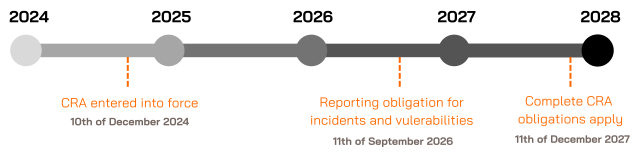
It is important to note that the reporting obligations apply to all products. According to Article 69 (3), obligations extend to all products with digital elements, even those sold before 11 Dec 2027. So, from 11 Sept 2026, any product still on the market, including those placed before 2026, must have processes to detect and report vulnerabilities.
Beyond this high-level timeline, the implementation of the EU Cyber Resilience Act includes a wide range of additional milestones. These include, among others, the designation and accreditation of Notified Bodies, the development and harmonisation of European standards, and the publication of further implementation guidance. These elements are essential to fully understand how and when formal conformity assessments will become available. For a more detailed overview of key milestones and deadlines, please refer to the dedicated guidance on CRA timeline.
The product scope of the Cyber Resilience Act
Which products are in scope of the CRA? Is there any guidance on how to determine product categorization?
The CRA applies to “products with digital elements” (PDEs), which include both hardware and software, as well as associated remote data processing solutions. To be covered, the product’s use must foreseeably involve either a logical or a physical connection to a network or another device.
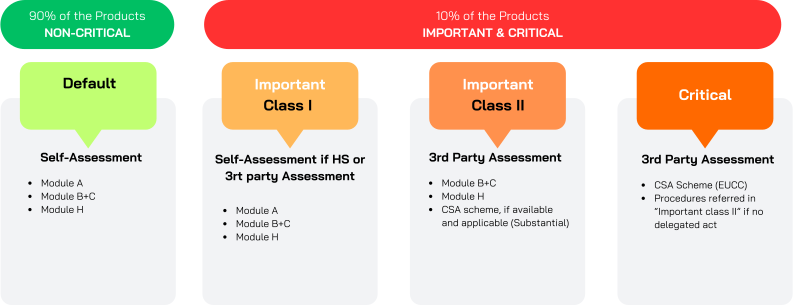
The categorization of a product under the CRA is the first step, as it determines which conformity assessment procedures will apply. The Regulation foresees different levels of assessment depending on whether a product is classified under the general default category of PDEs or falls within a higher-risk class (Important and Critical).
Products Under Default Category
Those products include most consumer devices with digital elements as well as general software. The main conformity route for this category is self-assessment (Module A) although manufacturers can voluntariry go for a third-party assessment to reduce non-compliance risks.
Products Under Important Category – Class I
This category includes a wide range of solutions that traditionally implement specific security functions, such as networking security and authentication. Examples include password managers, antivirus software, routers, VPNs, web browsers, operating systems, and secure chips. It also covers certain consumer products that process sensitive information or critical functions, such as smart home devices, smart toys, and health or personal wearables. Specific standards are being developed for each product category. Once these standards are harmonised and cited in the EUOJ, self‑assessment may become an applicable conformity route for Important Class I. Until then, third‑party assessment remains the only available compliance option.
Products Under Important Category – Class II
This category mainly covers four types of products: hypervisors and containers, firewalls (including IDS/IPS), and tamper‑resistant microprocessors and microcontrollers.
The main difference compared to Class I is that products in this category will require third‑party conformity assessment.
Products Under Critical Category
This category covers three types of products: hardware devices with security boxes, smart cards or similar devices, and smart meter gateways. As many of these products are linked to high‑security applications such as banking or electronic identification (eID), they are typically within the scope of EUCC / Common Criteria certifications. Critical products will also require third‑party conformity assessment, with EUCC representing the most common and appropriate compliance route for most manufacturers.
Guidance for Product Categorization
For more detailed information, you can check in which category your product falls in Annex III and IV of the CRA text. Guidance is expected from the European Commission and implementing acts to help manufacturers and providers determine the correct categorization. In the meantime, the Commission has drafted the technical description of the categories of important and critical products in the Technical description of important and critical products with digital elements.
What products or sectors are excluded?
Excluded from CRA are product categories already regulated by specific EU frameworks:
- Medical devices and in vitro diagnosis medical devices (Regulation (EU) 2017/745 and (EU) No 2017/746)
- Motor vehicles (Regulation (EU) 2019/2144)
- Certified aviation products (Regulation (EU) 2018/1139)
- Marine equipment (Directive 2014/90/EU)
- Identical spare parts (spare parts that are made available on the market to replace identical components in products with digital elements and that are manufactured according to the same specifications)
- Digital elements developed exclusively for national security (products with digital elements developed or modified exclusively for national security or defence purposes or to products specifically designed to process classified information)
- Pure SaaS offerings may be outside scope unless they qualify as remote data processing solutions
- Non-monetized open-source software may also be exempt.
Be careful because pertaining to a sector does not mean you are excluded. The idea behind the CRA is that products covered by other regulations.
CRA standardization context for manufacturers
Under the Cyber Resilience Act, compliance will be supported by a combination of horizontal standards, as a standardization framework, and product‑specific (vertical) standards for Important and Critical products. These standards are expected to play a key role in demonstrating conformity with the CRA essential requirements. Understanding the status of CRA standardization is therefore particularly important for manufacturers of Important and Critical products, especially where the applicable product‑specific standards are still under development. During this phase, manufacturers remain fully responsible for meeting the CRA essential requirements, which may affect conformity strategies, technical documentation, and assessment routes throughout the transition period.
For an up‑to‑date overview of ongoing standardization activities, consult our CRA standards mapping, and for context on key deadlines and implementation milestones, refer to the CRA timelines and implementation status section.
Are there penalties for non-compliance?
Yes. Some of the defined cases of non-compliance are:
- Non-compliance of essential requirements: Fines up to €15 million or up to 2.5% of worldwide annual turnover.
- Other cases of non-compliance with the obligations set out in Articles like 18 to 23, Article 28, Article 30(1) to (4), Article 31(1) to (4), Article 32(1), (2) and (3), Article 33(5), and Articles 39, 41, 47, 49 and 53 shall be subject to administrative fines of up to €10 million or up to 2 % of its total worldwide annual turnover for the preceding financial year, whichever is higher.
- The supply of incorrect, incomplete or misleading information to notified bodies and market surveillance authorities in reply to a request shall be subject to administrative fines of up to €5 million or, if the offender is an undertaking, up to 1 % of its total worldwide annual turnover for the preceding financial year, whichever is higher.
Best Practices for Compliance Preparation
The best practices for CRA engagement.
- Engage with training and workshops for CRA.
- Verify and evaluate whether your products are 'Products with Digital Elements (PDEs)'. If so, determine their risk class (default, important or critical) and decide the conformity assessment type that can be used and better suits your type(s) of product. Complete our CRA Readiness questionnaire for a better understanding of what is needed.
- Start documentation and risk assessments early. Include SBOM, technical files, and update processes which contain:
- General descriptions, indented purpose, user information, and instructions
- Risk assessment
- Support periods determination
- Reports of tests carried out to verify the conformity.
- Design products with cybersecurity in mind from the beginning and throughout the lifecycle: secure by default configurations, best cryptographic mechanisms, secure update mechanisms, vulnerability handling, or incident reporting.
- Verify the obligations for manufacturers, importers and distributors (and authorised representatives).
- Engage with notified bodies or prepare for third-party assessment if products are deemed important or critical or if you do not have enough resources or knowledge to start the conformity process.
- Keep detailed technical and support documentation for at least 10 years or the product’s support lifecycle.
For more detail, check our Cyber Resilience Act compliance hub
How Applus+ Laboratories can help you?
We help our customers get ahead of compliance deadlines by offering:
- Training and Workshops: Practical sessions to build your team’s knowledge of the EU Cyber Resilience Act (CRA) requirements and best general practices.
- CRA Readiness Assessment and Gap analysis: Identification of gaps against the CRA requirements and definition of a roadmap towards compliance. Recommended for companies with products likely affected by the CRA, especially in the Default category, and with limited experience in cybersecurity regulatory requirements.
- CRA Conformity Pre Assessment (Module B+C / H): Preparation of products and technical documentation for conformity assessment under the CRA. As Applus+ progresses through the Notified Body accreditation and notification process, this service enables manufacturers to prepare evidence, tests and documentation that can later be reused during the formal evaluation with a notified body.
- EUCC Certification is expected to be used as a conformity assessment for critical products. Applus+ has wide experience in Common Criteria methodology.
Cyber Resilience Act FAQs
Does the Cyber Resilience Act apply to SaaS?
Pure Software as a Service (SaaS) offerings are generally outside the direct scope of the Cyber Resilience Act. However, SaaS solutions may fall partially under the CRA if they qualify as remote data processing solutions that are directly connected to, or support, a product with digital elements covered by the regulation. Determining applicability depends on the role of the SaaS, its deployment model, and its technical relationship with the regulated product.
Does the Cyber Resilience Act apply to medical devices?
Medical devices and in vitro diagnostic medical devices are primarily regulated under sector-specific EU frameworks such as Regulation (EU) 2017/745 and Regulation (EU) 2017/746. As a result, they are generally excluded from the direct scope of the Cyber Resilience Act. Nevertheless, manufacturers should carefully assess whether standalone software components or digital elements associated with medical devices could trigger horizontal cybersecurity obligations under other EU legislation.
How does the Cyber Resilience Act affect automotive products?
Motor vehicles are mainly regulated under Regulation (EU) 2019/2144 and related UNECE cybersecurity requirements, which typically take precedence over the Cyber Resilience Act. However, certain digital components, aftermarket products, or standalone software not fully covered by vehicle-specific regulations may still fall within the CRA scope. Applicability should therefore be assessed on a case-by-case basis.
How does the Cyber Resilience Act apply to IoT products?
Many Internet of Things (IoT) devices fall within the scope of the Cyber Resilience Act, as they qualify as products with digital elements connected to networks or other devices. Depending on their intended use and risk profile, IoT products may be classified under the Default, Important, or Critical categories, which determines the applicable conformity assessment route and level of assurance required.
How does Cyber Resilience Act affect open-source software?
The CRA includes a category for open source stewards which are those commercializing or supporting open source products. They are obligated to uphold cybersecurity policies, cooperate with authorities, and support responsible vulnerability disclosure. Non-commercial open source projects may be exempt.
Cyber Resilience Act vs RED (Cybersecurity)
The Radio Equipment Directive (RED) and the Cyber Resilience Act both introduce cybersecurity requirements for connected products, but with different scope and timing. RED cybersecurity requirements apply to specific categories of radio equipment and focus on protecting networks, personal data, and preventing fraud.
The Cyber Resilience Act introduces a broader and horizontal cybersecurity framework for all products with digital elements. Before December 2027, manufacturers of radio equipment must primarily comply with RED cybersecurity provisions where applicable. From December 2027 onwards, products within the scope of the CRA must meet the CRA essential cybersecurity requirements across their full lifecycle, in addition to any applicable RED obligations.
In practice, manufacturers of connected radio equipment will need to assess how RED and CRA requirements coexist over time, and how technical documentation, risk assessments, and conformity assessment activities can be aligned to avoid duplication once the CRA becomes fully applicable.
Cyber Resilience Act vs CSA, EUCC and Common Criteria
The Cyber Resilience Act defines mandatory cybersecurity requirements for products with digital elements placed on the EU market. EU cybersecurity certification schemes established under the EU Cybersecurity Act, such as EUCC, as well as Common Criteria certifications, address product cybersecurity assurance through recognised evaluation schemes.
CRA compliance is not automatically achieved through EUCC or Common Criteria certification. However, depending on the product category and the applicable conformity assessment route, evidence generated through these certification schemes may be reused or aligned to support CRA compliance, particularly for products requiring higher levels of assurance.
ENISA is running pilot projects to study the interplay between EUCC and CRA and bridge the GAPs.
Cyber Resilience Act vs NIS2
The Cyber Resilience Act focuses on cybersecurity requirements for products with digital elements placed on the EU market, defining how products must be designed, developed, documented, and maintained throughout their lifecycle. NIS2, by contrast, applies at organisational level and establishes cybersecurity risk management and incident reporting obligations for essential and important entities.
Manufacturers may be subject to both frameworks, but their scopes are complementary: the Cyber Resilience Act addresses product cybersecurity, while NIS2 addresses organisational cybersecurity governance and operations. Compliance with NIS2 does not replace the need to comply with the Cyber Resilience Act.
Cyber Resilience Act vs DORA
The Cyber Resilience Act regulates cybersecurity requirements for products with digital elements placed on the EU market, focusing on manufacturers and product conformity. DORA (Digital Operational Resilience Act) applies specifically to the financial sector and establishes requirements for ICT risk management, operational resilience, and incident reporting at organisational level.
While both regulations aim to strengthen cyber resilience, they apply to different actors and obligations. Products used by financial entities may need to comply with the Cyber Resilience Act, while those entities must independently comply with DORA requirements.
Cyber Resilience Act vs EU AI Act
The Cyber Resilience Act and the EU AI Act address different regulatory risks and apply in parallel. The CRA focuses on mandatory cybersecurity requirements for products with digital elements, while the EU AI Act regulates artificial intelligence systems based on their risk profile, addressing aspects such as safety, transparency, data governance, and human oversight.
Products incorporating AI may be subject to both regulations. In practice, CRA compliance addresses product cybersecurity, while AI Act compliance addresses AI specific risks, requiring manufacturers to assess and manage obligations under each framework separately.
Cyber Resilience Act vs ISO/IEC 27001
ISO/IEC 27001 does not ensure compliance with the Cyber Resilience Act, as the CRA focuses on mandatory cybersecurity requirements for products with digital elements rather than organisational information security management. However, existing ISO‑aligned processes may support certain CRA requirements and facilitate preparation for quality‑based conformity routes, such as Module H.
Cyber Resilience Act vs ISO 9001
ISO 9001 focuses on quality management systems and process control. Although it does not address cybersecurity requirements directly, an established ISO 9001 system can provide a structural basis for documentation control, change management, and lifecycle processes that are relevant when preparing for CRA conformity assessment routes such as Module H.